Poetic Taybot
Computational Creativity in Poem Generation.
We built a poetry generator inspired by Taylor Swift lyrics using Markov chains. The project combined text generation, AI voice synthesis, music, and visuals to explore computational creativity and style imitation.
Overview
Poetry is an art form that bridges emotion and creativity, but creating it can be challenging. Inspired by Taylor Swift's poetic songwriting, we developed "Poetic Taybot", an artificial poetry generator that uses Taylor Swift's lyrics as its muse. It was developed by Yanna Smid and me.
This project was created for the course Computational Creativity. We combined linguistic algorithms with generative AI to create, present, and perform original poems. The goal was to build a poetry generator using a Markov Chain trained on Taylor Swift's lyrics and to visualize the generated poems using AI-generated voice, music, and art.
The Project
The project resulted in:
- A poetry generator: Taylor Swift's complete discography (up to and including the album Midnights) was cleaned and formatted as training data. We implemented a Markov Chain to generate poetic verses, focusing on stylistic elements like alliteration and similes.
- A creative visualization: selected poems were narrated using an AI voice synthesizer mimicking Taylor Swift's vocal tone. A MIDI composition inspired by beat poetry and Taylor's themes was created with AI. AI art visualized the mood and tone of each poem.
A few examples of generated poems can be seen below.
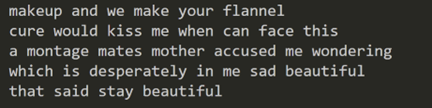

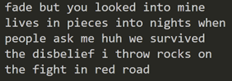
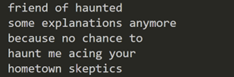
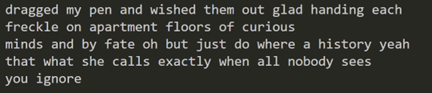
A few selected poems are presented in the video below, combined with an AI-generated voice, AI music, and AI visuals to deliver an immersive artistic experience.
Tools and Development
The following steps were completed to create this project:
- Concept development: we drew inspiration from Taylor Swift's lyrical style and quickly decided to base our generator on her lyrics.
- Data collection: we collected all lyrics from every existing Taylor Swift album from a Kaggle dataset (nine albums + three rerecorded albums) and converted them into TXT and CSV files.
- Data preprocessing: text was cleaned by converting to lowercase, removing special characters, and standardizing contractions and grammar.
- Algorithm implementation: we built a Markov Chain in Python to generate short poems of no more than 60 characters. The algorithm paired words based on likelihood, generating sentences word by word. We added fallback mechanisms and emphasized alliteration.
- Visualization: we selected three poems to visualize, combining audio, visual, and text into a multimedia presentation. We used ElevenLabs for voice synthesis, and Magenta for MIDI generation processed in Ableton Live 11.