Beyond the Mood Swings
Tracking Anxiety and Social Cognition Across the Menstrual Cycle
By Nikki Rademaker
Overview
For my Master's thesis in Creative Intelligence & Technology at Leiden University, daily anxiety and affective Theory of Mind (ToM) performance were studied across menstrual cycle phases. I tracked state anxiety for two full cycles in participants with a regular menstrual cycle by sending out daily surveys containing the State-Trait Anxiety Inventory - S (STAI-S) (Spielberger et al., 1972). Furthermore, affective ToM performance was tested twice per cycle by short-story tests based on the Adult Faux Pas Recognition Test (FPRT) (Stone et al., 1998).
Studying these topics might help us explain changes in emotions and social functioning that some people notice but cannot seem to understand. This knowledge can lead to greater self-understanding, self-compassion, and even understanding from others.
The Project
The menstrual cycle is a hormonal process that prepares the female body for a possible pregnancy. It repeats monthly if pregnancy does not occur and consists of four phases: menstrual, follicular, ovulation, and luteal. Research on the menstrual cycle has long been neglected, resulting in major gaps in understanding its patterns and effects. These gaps persist due to the complexity of the topic, its underexplored nature, and the lack of a standardized and reliable research method. Therefore, this study examined how menstrual cycle phases affect individuals' general anxiety levels and affective ToM abilities. The goal was to understand whether specific cycle phases influence mental health and social-cognitive processing. Anxiety was examined across the menstrual, follicular (with and without menstruation), and luteal phases, while ToM was measured in the mid-follicular and mid-to-late luteal phases.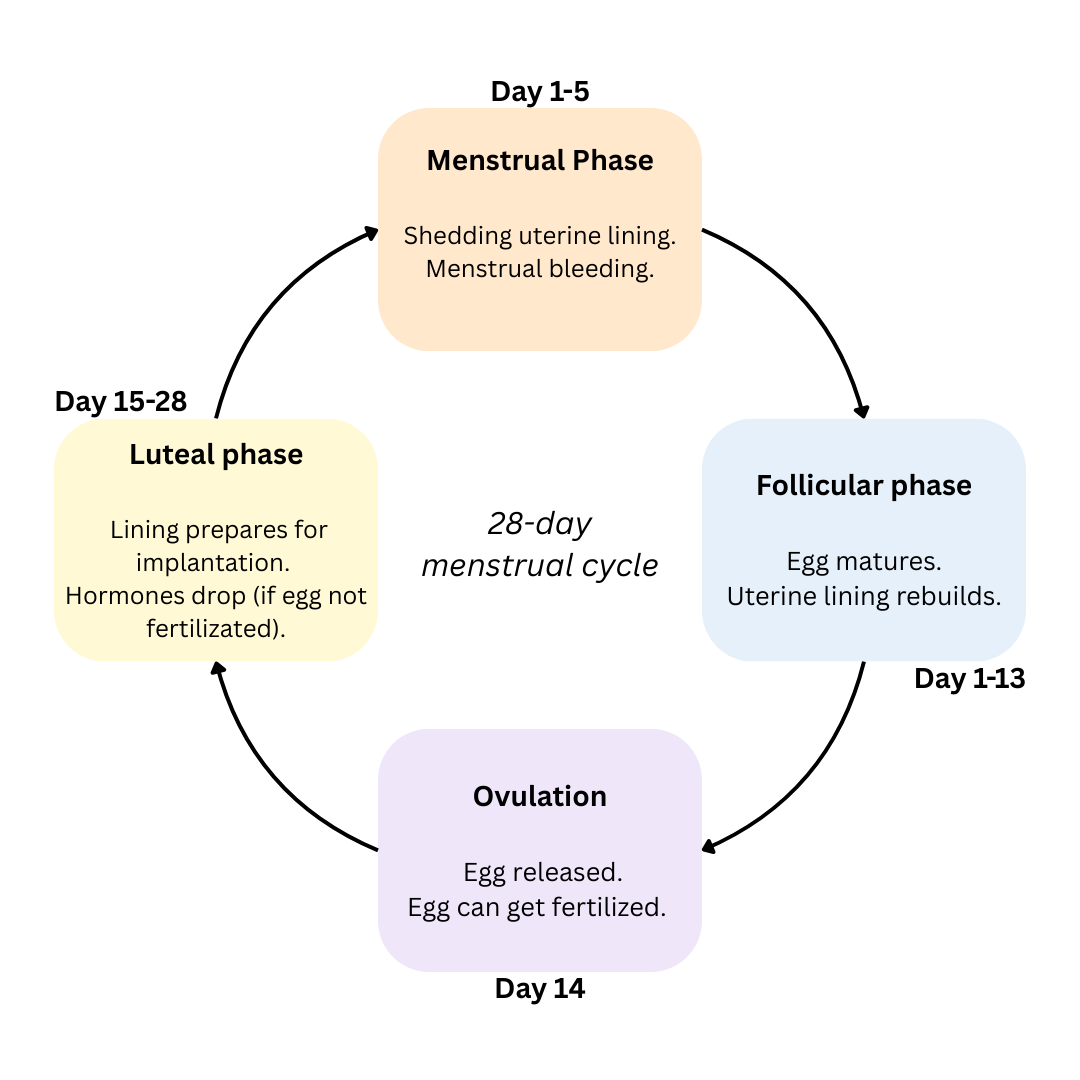
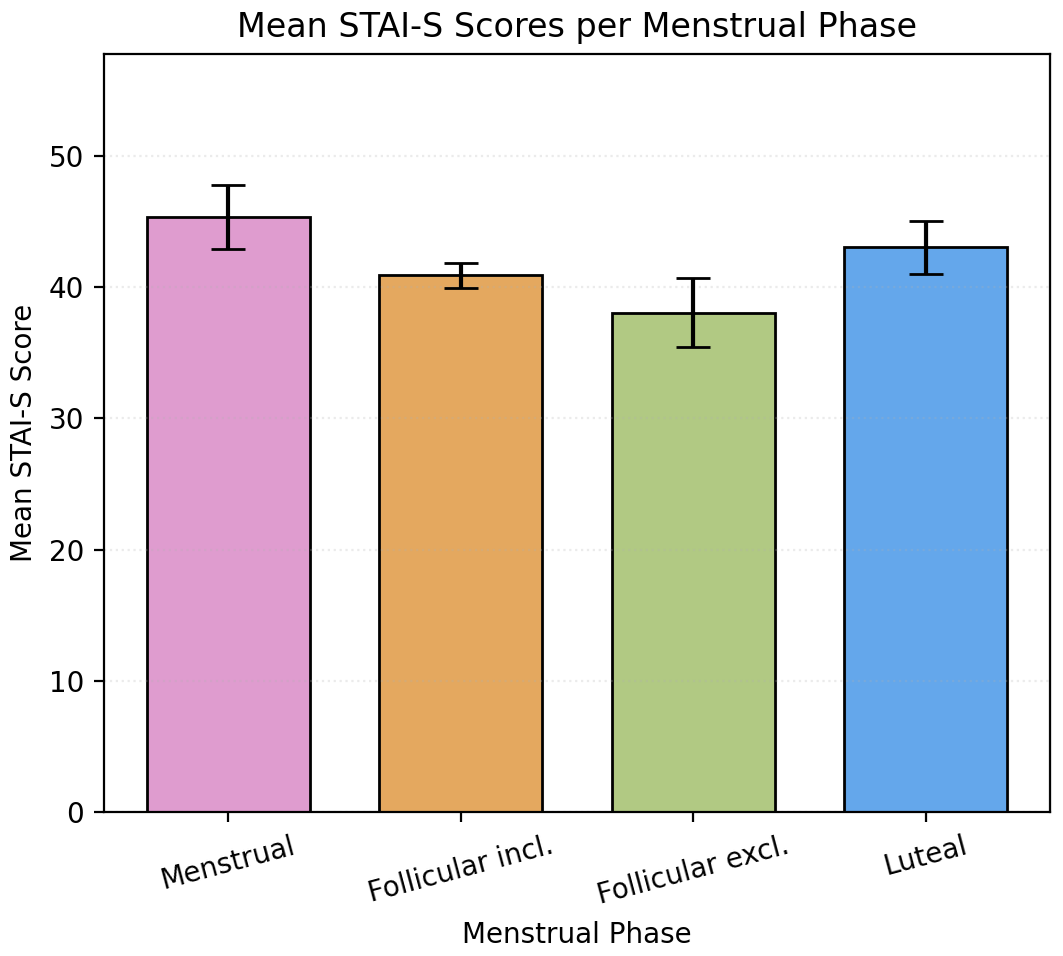
Analysis of the collected data (with n = 20 for anxiety, n = 17 for ToM) led to the figures shown below. As can be seen in the first bar chart, anxiety
varied across phases. Anxiety was reported to be highest during the menstrual phase (low estrogen levels)
and lowest during the rest of the follicular phase following menstruation (high estrogen levels).
A repeated-measures ANOVA confirmed a significant effect of cycle phase on anxiety. Post hoc comparisons showed that
anxiety was significantly higher during menstruation compared to the follicular phase. Anxiety levels during the luteal phase were moderate
without significant differences compared to the other phases.
In short, the results indicate that anxiety levels vary across menstrual cycle phases.
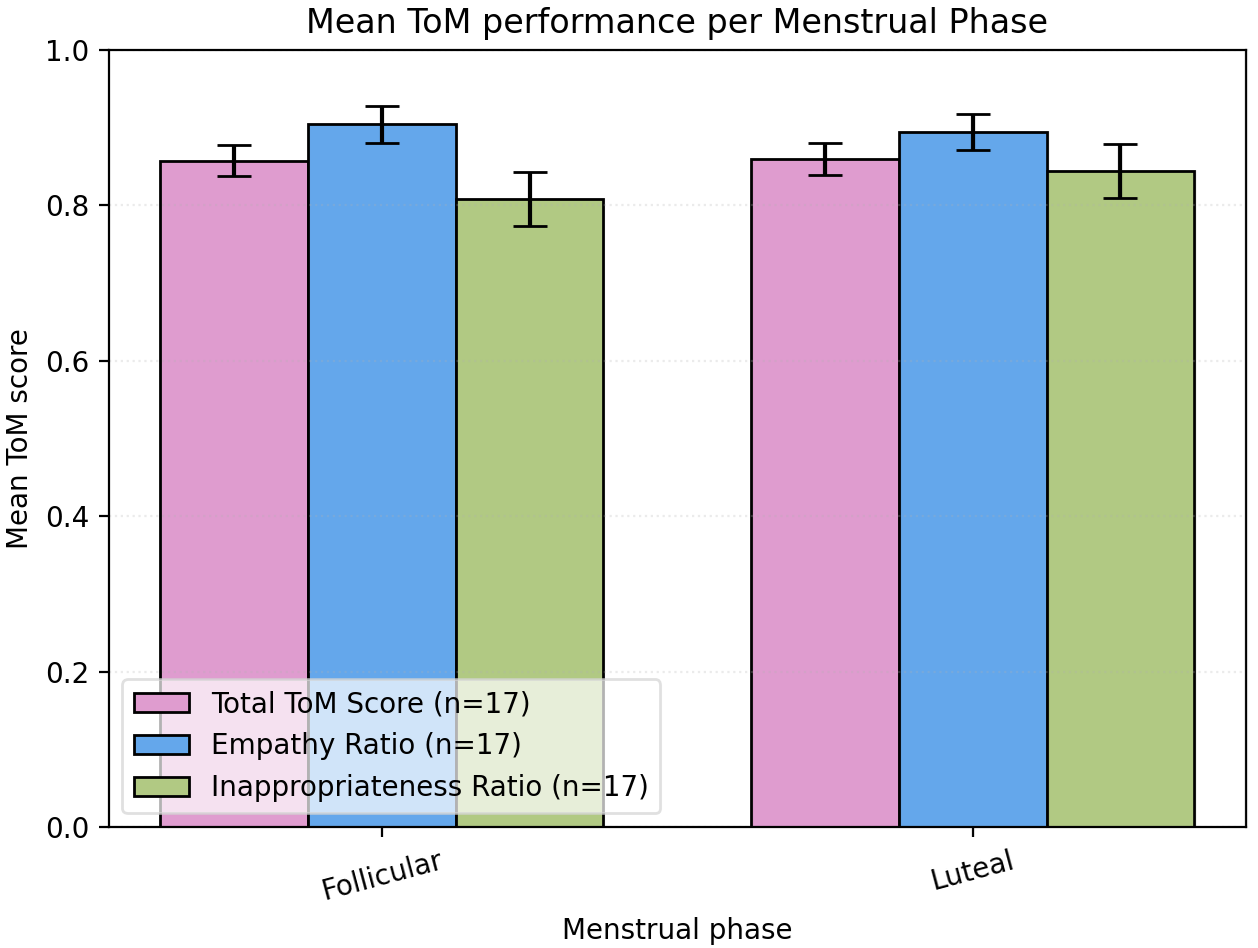
On the other hand, no significant differences were found in ToM performance between phases. The total ToM score reflected overall
social understanding, the Empathy ratio measured emotional sensitivity toward others, and the Understanding
Inappropriateness ratio measured awareness of socially inappropriate remarks. All these scores remained stable
across phases in this study.
Tools
- Qualtrics (anxiety surveys and ToM tests)
- Excel (daily tracking and ToM scoring)
- Python (data preprocessing, analysis and visualization)
- JASP (statistics)
Abstract
Research on how ovarian hormonal changes across the menstrual cycle influence anxiety and social cognition remains limited. This study examined whether naturally cycling individuals experience varying levels of state anxiety and affective Theory of Mind (ToM) performance across menstrual phases. For two full menstrual cycles, participants completed daily surveys measuring state anxiety using the State-Trait Anxiety Inventory. They also completed a total of four affective ToM tests based on the Adult Faux Pas Recognition Test. State anxiety was assessed daily across three phases (menstrual, follicular, luteal), and affective ToM performance was assessed during two phases (mid-follicular and mid-to-late luteal). A repeated measures ANOVA showed a significant difference in anxiety between menstrual cycle phases. The mean anxiety score was highest during menstruation and significantly greater than during the follicular phase. The lowest anxiety was found in the follicular phase excluding menstruation. No significant difference was observed between the luteal phase and the other phases. Paired samples t-tests showed no significant difference in affective ToM performance between the mid-follicular and mid-to-late luteal phases. In conclusion, the findings indicate that the menstrual cycle influences anxiety levels but not affective ToM performance. However, the small sample sizes (n = 20 for anxiety, n = 17 for ToM) and phase predictions based on self-reported cycle data limit the generalizability of these results. The findings contribute to closing the data gap on how the menstrual cycle affects everyday fluctuations in anxiety and take a step toward exploring potential phase effects on social cognition.My full thesis can be found here.